 Add to Chrome
 Add to Firefox
 Add to Edge
Decoding in Geometry: Alleviating Embedding-Space Crowding for Complex Reasoning
Jan 30, 2026
Sampling-based decoding underlies complex reasoning in large language models (LLMs), where decoding strategies critically shape model behavior. Temperature- and truncation-based methods reshape the next-token distribution through global probability reweighting or thresholding to balance the quality-diversity tradeoff. However, they operate solely on token probabilities, ignoring fine-grained relationships among tokens in the embedding space. We uncover a novel phenomenon, embedding-space crowding, where the next-token distribution concentrates its probability mass on geometrically close tokens in the embedding space. We quantify crowding at multiple granularities and find a statistical association with reasoning success in mathematical problem solving. Motivated by this finding, we propose CraEG, a plug-and-play sampling method that mitigates crowding through geometry-guided reweighting. CraEG is training-free, single-pass, and compatible with standard sampling strategies. Experiments on multiple models and benchmarks demonstrate improved generation performance, with gains in robustness and diversity metrics.

MiMo-V2-Flash Technical Report
Jan 08, 2026We present MiMo-V2-Flash, a Mixture-of-Experts (MoE) model with 309B total parameters and 15B active parameters, designed for fast, strong reasoning and agentic capabilities. MiMo-V2-Flash adopts a hybrid attention architecture that interleaves Sliding Window Attention (SWA) with global attention, with a 128-token sliding window under a 5:1 hybrid ratio. The model is pre-trained on 27 trillion tokens with Multi-Token Prediction (MTP), employing a native 32k context length and subsequently extended to 256k. To efficiently scale post-training compute, MiMo-V2-Flash introduces a novel Multi-Teacher On-Policy Distillation (MOPD) paradigm. In this framework, domain-specialized teachers (e.g., trained via large-scale reinforcement learning) provide dense and token-level reward, enabling the student model to perfectly master teacher expertise. MiMo-V2-Flash rivals top-tier open-weight models such as DeepSeek-V3.2 and Kimi-K2, despite using only 1/2 and 1/3 of their total parameters, respectively. During inference, by repurposing MTP as a draft model for speculative decoding, MiMo-V2-Flash achieves up to 3.6 acceptance length and 2.6x decoding speedup with three MTP layers. We open-source both the model weights and the three-layer MTP weights to foster open research and community collaboration.
MiMo-Audio: Audio Language Models are Few-Shot Learners
Dec 29, 2025Existing audio language models typically rely on task-specific fine-tuning to accomplish particular audio tasks. In contrast, humans are able to generalize to new audio tasks with only a few examples or simple instructions. GPT-3 has shown that scaling next-token prediction pretraining enables strong generalization capabilities in text, and we believe this paradigm is equally applicable to the audio domain. By scaling MiMo-Audio's pretraining data to over one hundred million of hours, we observe the emergence of few-shot learning capabilities across a diverse set of audio tasks. We develop a systematic evaluation of these capabilities and find that MiMo-Audio-7B-Base achieves SOTA performance on both speech intelligence and audio understanding benchmarks among open-source models. Beyond standard metrics, MiMo-Audio-7B-Base generalizes to tasks absent from its training data, such as voice conversion, style transfer, and speech editing. MiMo-Audio-7B-Base also demonstrates powerful speech continuation capabilities, capable of generating highly realistic talk shows, recitations, livestreaming and debates. At the post-training stage, we curate a diverse instruction-tuning corpus and introduce thinking mechanisms into both audio understanding and generation. MiMo-Audio-7B-Instruct achieves open-source SOTA on audio understanding benchmarks (MMSU, MMAU, MMAR, MMAU-Pro), spoken dialogue benchmarks (Big Bench Audio, MultiChallenge Audio) and instruct-TTS evaluations, approaching or surpassing closed-source models. Model checkpoints and full evaluation suite are available at https://github.com/XiaomiMiMo/MiMo-Audio.
RICo: Refined In-Context Contribution for Automatic Instruction-Tuning Data Selection
May 18, 2025Data selection for instruction tuning is crucial for improving the performance of large language models (LLMs) while reducing training costs. In this paper, we propose Refined Contribution Measurement with In-Context Learning (RICo), a novel gradient-free method that quantifies the fine-grained contribution of individual samples to both task-level and global-level model performance. RICo enables more accurate identification of high-contribution data, leading to better instruction tuning. We further introduce a lightweight selection paradigm trained on RICo scores, enabling scalable data selection with a strictly linear inference complexity. Extensive experiments on three LLMs across 12 benchmarks and 5 pairwise evaluation sets demonstrate the effectiveness of RICo. Remarkably, on LLaMA3.1-8B, models trained on 15% of RICo-selected data outperform full datasets by 5.42% points and exceed the best performance of widely used selection methods by 2.06% points. We further analyze high-contribution samples selected by RICo, which show both diverse tasks and appropriate difficulty levels, rather than just the hardest ones.
ICon: In-Context Contribution for Automatic Data Selection
May 08, 2025Data selection for instruction tuning is essential for improving the performance of Large Language Models (LLMs) and reducing training cost. However, existing automated selection methods either depend on computationally expensive gradient-based measures or manually designed heuristics, which may fail to fully exploit the intrinsic attributes of data. In this paper, we propose In-context Learning for Contribution Measurement (ICon), a novel gradient-free method that takes advantage of the implicit fine-tuning nature of in-context learning (ICL) to measure sample contribution without gradient computation or manual indicators engineering. ICon offers a computationally efficient alternative to gradient-based methods and reduces human inductive bias inherent in heuristic-based approaches. ICon comprises three components and identifies high-contribution data by assessing performance shifts under implicit learning through ICL. Extensive experiments on three LLMs across 12 benchmarks and 5 pairwise evaluation sets demonstrate the effectiveness of ICon. Remarkably, on LLaMA3.1-8B, models trained on 15% of ICon-selected data outperform full datasets by 5.42% points and exceed the best performance of widely used selection methods by 2.06% points. We further analyze high-contribution samples selected by ICon, which show both diverse tasks and appropriate difficulty levels, rather than just the hardest ones.
Unveiling Latent Information in Transaction Hashes: Hypergraph Learning for Ethereum Ponzi Scheme Detection
Mar 27, 2025With the widespread adoption of Ethereum, financial frauds such as Ponzi schemes have become increasingly rampant in the blockchain ecosystem, posing significant threats to the security of account assets. Existing Ethereum fraud detection methods typically model account transactions as graphs, but this approach primarily focuses on binary transactional relationships between accounts, failing to adequately capture the complex multi-party interaction patterns inherent in Ethereum. To address this, we propose a hypergraph modeling method for the Ponzi scheme detection method in Ethereum, called HyperDet. Specifically, we treat transaction hashes as hyperedges that connect all the relevant accounts involved in a transaction. Additionally, we design a two-step hypergraph sampling strategy to significantly reduce computational complexity. Furthermore, we introduce a dual-channel detection module, including the hypergraph detection channel and the hyper-homo graph detection channel, to be compatible with existing detection methods. Experimental results show that, compared to traditional homogeneous graph-based methods, the hyper-homo graph detection channel achieves significant performance improvements, demonstrating the superiority of hypergraph in Ponzi scheme detection. This research offers innovations for modeling complex relationships in blockchain data.
Introducing Unbiased Depth into 2D Gaussian Splatting for High-accuracy Surface Reconstruction
Mar 09, 2025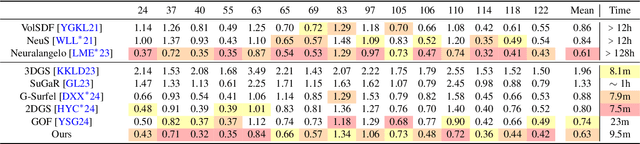
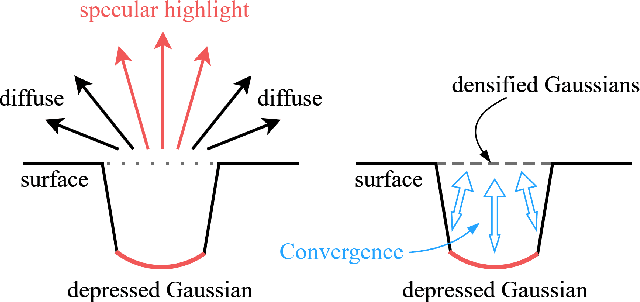
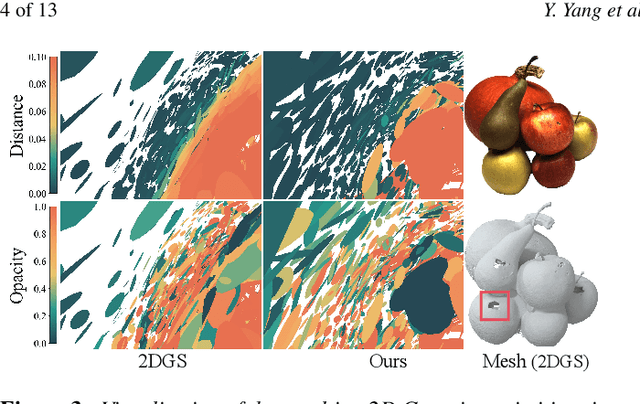
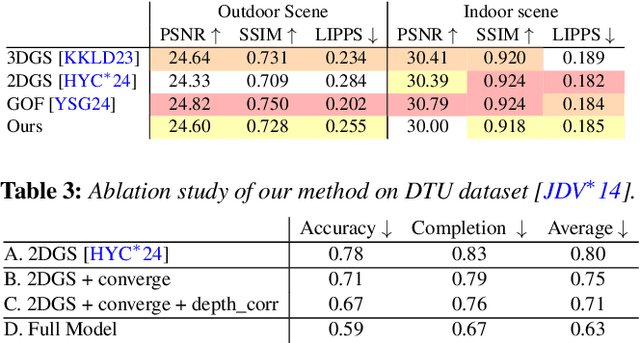
Recently, 2D Gaussian Splatting (2DGS) has demonstrated superior geometry reconstruction quality than the popular 3DGS by using 2D surfels to approximate thin surfaces. However, it falls short when dealing with glossy surfaces, resulting in visible holes in these areas. We found the reflection discontinuity causes the issue. To fit the jump from diffuse to specular reflection at different viewing angles, depth bias is introduced in the optimized Gaussian primitives. To address that, we first replace the depth distortion loss in 2DGS with a novel depth convergence loss, which imposes a strong constraint on depth continuity. Then, we rectified the depth criterion in determining the actual surface, which fully accounts for all the intersecting Gaussians along the ray. Qualitative and quantitative evaluations across various datasets reveal that our method significantly improves reconstruction quality, with more complete and accurate surfaces than 2DGS.
KnowLogic: A Benchmark for Commonsense Reasoning via Knowledge-Driven Data Synthesis
Mar 08, 2025Current evaluations of commonsense reasoning in LLMs are hindered by the scarcity of natural language corpora with structured annotations for reasoning tasks. To address this, we introduce KnowLogic, a benchmark generated through a knowledge-driven synthetic data strategy. KnowLogic integrates diverse commonsense knowledge, plausible scenarios, and various types of logical reasoning. One of the key advantages of KnowLogic is its adjustable difficulty levels, allowing for flexible control over question complexity. It also includes fine-grained labels for in-depth evaluation of LLMs' reasoning abilities across multiple dimensions. Our benchmark consists of 3,000 bilingual (Chinese and English) questions across various domains, and presents significant challenges for current LLMs, with the highest-performing model achieving only 69.57\%. Our analysis highlights common errors, such as misunderstandings of low-frequency commonsense, logical inconsistencies, and overthinking. This approach, along with our benchmark, provides a valuable tool for assessing and enhancing LLMs' commonsense reasoning capabilities and can be applied to a wide range of knowledge domains.
Beyond Single Frames: Can LMMs Comprehend Temporal and Contextual Narratives in Image Sequences?
Feb 19, 2025Large Multimodal Models (LMMs) have achieved remarkable success across various visual-language tasks. However, existing benchmarks predominantly focus on single-image understanding, leaving the analysis of image sequences largely unexplored. To address this limitation, we introduce StripCipher, a comprehensive benchmark designed to evaluate capabilities of LMMs to comprehend and reason over sequential images. StripCipher comprises a human-annotated dataset and three challenging subtasks: visual narrative comprehension, contextual frame prediction, and temporal narrative reordering. Our evaluation of $16$ state-of-the-art LMMs, including GPT-4o and Qwen2.5VL, reveals a significant performance gap compared to human capabilities, particularly in tasks that require reordering shuffled sequential images. For instance, GPT-4o achieves only 23.93% accuracy in the reordering subtask, which is 56.07% lower than human performance. Further quantitative analysis discuss several factors, such as input format of images, affecting the performance of LLMs in sequential understanding, underscoring the fundamental challenges that remain in the development of LMMs.
E2VIDiff: Perceptual Events-to-Video Reconstruction using Diffusion Priors
Jul 11, 2024Event cameras, mimicking the human retina, capture brightness changes with unparalleled temporal resolution and dynamic range. Integrating events into intensities poses a highly ill-posed challenge, marred by initial condition ambiguities. Traditional regression-based deep learning methods fall short in perceptual quality, offering deterministic and often unrealistic reconstructions. In this paper, we introduce diffusion models to events-to-video reconstruction, achieving colorful, realistic, and perceptually superior video generation from achromatic events. Powered by the image generation ability and knowledge of pretrained diffusion models, the proposed method can achieve a better trade-off between the perception and distortion of the reconstructed frame compared to previous solutions. Extensive experiments on benchmark datasets demonstrate that our approach can produce diverse, realistic frames with faithfulness to the given events.